AI codes faster than you. So what should a developer learn now?
Worried AI will take your job? I went through METR, DORA, Stanford and Stack Overflow data to see where developers still matter and what to learn next.


Contents
If you write code for a living, you’ve probably had that moment: an AI tool spits out a whole function in a few seconds, and you think “So what am I supposed to learn now that won’t go to waste?” I asked myself the exact same thing, so I figured I’d just write it down.
The person asking could be a second-year student or someone with ten years on the job. Online, people split into two camps. One says programming is about to die, switch careers. The other says AI is just a tool, carry on as before. Each side has its reasons, but I wanted to see the data first.
So I went and read the most reliable public research out there, looked at what it actually measured, and only then drew a conclusion. By the end you’ll know how much AI really helps, who is getting hit the hardest, and what to learn and do now. Here’s the answer up front so you can skip the scrolling:
When generating code gets close to free, the expensive part that remains is knowing what the real problem is, knowing whether the result is right or wrong, and understanding the system deeply enough to own it when it runs for real. To keep your value, you need to learn the fundamentals more deeply than before, not less.
Below is the data that got me there.
AI does make people faster, but not everyone
One large study on AI and productivity looked at more than 5,000 customer support agents and was published in the Quarterly Journal of Economics in 2025. With an AI assistant, requests handled per hour went up about 14%. Split by group, though, it gets interesting: newcomers improved by as much as 34%, while veterans barely moved.1
What about programming? In July 2025, METR (an independent AI research group) ran a proper controlled trial. They recruited 16 experienced open-source developers (open source meaning code anyone can read and contribute to) and gave them 246 real tasks in the very repos they already contribute to. Whether a task allowed AI or not was decided at random. Result: with AI, they were 19% slower.2
There’s more. Before starting, these same developers predicted they’d be 24% faster. After finishing, with the clock clearly showing they were slower, they still believed they’d been 20% faster. Perception and measurement went in opposite directions.
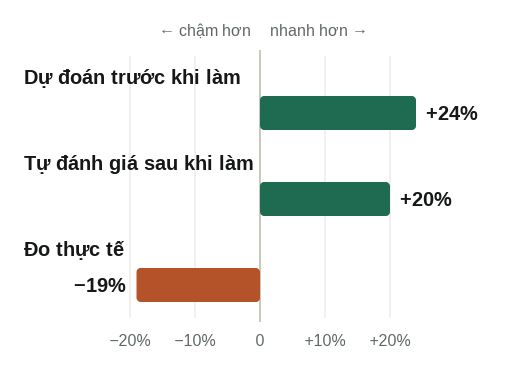
But don’t take this result into an argument just yet. METR itself says the study doesn’t prove AI slows down most developers. In February 2026 they ran it again. For the original developers the estimate was −18%, but with a confidence interval (the range the true number probably falls in) from −38% to +9%, so they admit the new data gives an unreliable signal. Part of the reason: more and more people refused to take part, because they didn’t want to work without AI. METR thinks this pulls the measured number below the true effect.3
That last detail is the one worth thinking about. We got used to these tools much faster than we could measure how much they help.
What this means for you: AI helps most with repetitive, pattern-based work and with people who are still learning. On hard work in a big system you already know by heart, not so clear. And the feeling of “I’m faster” can be off from reality by almost 40 percentage points. What to do: if you want to know for real, measure. Don’t trust the feeling.
Typing code is no longer the slow part
The 2025 Stack Overflow survey had more than 49,000 respondents. 84% use or plan to use AI tools. But 46% say they don’t trust the accuracy of what comes out. People use it, they just don’t trust it yet. The biggest frustration (picked by 66%) is answers that are “almost right, but not quite.” 45% find debugging AI-written code more tiring than writing it themselves.4
If you’ve been around a while, you know the feeling. The generated code looks clean, handles the easy cases fine, then breaks exactly at the spot you didn’t think to ask about.
At the team level, the DORA 2024 report (Google’s yearly survey on how well software teams deliver) found that as AI use went up, delivery speed dipped about 1.5% and stability dropped about 7.2%.5 A year later, with 90% of software people using AI, delivery speed started going up, but stability still moved the other way: more AI use still went with lower stability. DORA 2025 summed it up with an image I think is spot on: AI is an amplifier. It doesn’t fix a team, it amplifies what’s already there. Strong teams use AI to get even better. Struggling teams find their existing problems exposed and intensified.6

Put the two sources together and the slow part has moved. We used to be slow because we had to type. Now we’re slow because we have to read, test, and make sure the code that just appeared isn’t quietly breaking something. What to do: practice reading code fast, writing tests with a purpose, and opening logs and metrics in production (the real system serving real users) and understanding what’s going on. People who can do that are standing exactly where they’re needed.
It’s getting harder to break into the field
This part is harder to say, because it hits people about to start their first job. I’ll be straight.
Erik Brynjolfsson’s team at Stanford analyzed payroll data for millions of US workers through ADP (a large US payroll company). Earlier versions estimated that 22–25 year olds in jobs heavily exposed to AI, software development included, saw a 13% relative decline in employment compared with less exposed groups (data through July 2025), then 16% (data through September 2025). The latest version (August 2026, data through June 2026) switches to a simpler measure and shows employment for this group is 19% lower than it would be if it had kept pace with everyone else.7
A few details matter more than the headline number. The drop mostly comes from hiring fewer young people, not from more layoffs. It’s concentrated in jobs where AI does the work instead of people, and much less clear in jobs where AI works alongside people. And the authors themselves stress that this is an early signal, not proof that AI is the cause; they also see no sign of widespread job loss.
The reason is easy to see. The work we used to hand juniors so they could learn, like writing CRUD (the add, view, edit, delete screens), fixing small bugs, and setting up boilerplate (the repetitive scaffolding every project has), is exactly what AI does best. The practice work now gets done by a machine, and faster. The way in is still there, but the first step is thinner. What to do: newcomers need to show they can work at a higher level, earlier than the generation before them.
What knowledge goes stale fast, and what lasts
The World Economic Forum’s Future of Jobs Report 2025 surveyed more than 1,000 companies. They expect about 39% of workers’ core skills to change before 2030. The most cited skill is still analytical thinking, which 69% of companies consider essential.8
I split knowledge into two kinds. The syntax of a framework, tricks for a tool, prompt-writing hacks: these go stale every quarter. Algorithmic complexity, how a database uses indexes (lookup tables that find data without scanning everything), transactions, HTTP, concurrency: these have barely changed in decades. And they’re exactly what you need to grade the output of any tool. If you don’t understand why OFFSET is slow, you won’t notice that the pagination code you just got will fall over once the table hits a few million rows. And it always falls over at peak hours.

What if, in a few years, AI can do it all?
This is the best counterargument, so I won’t dodge it.
Say one day the tools write code with zero mistakes. Someone still has to decide what to build, and someone still has to answer for it when the system charges a customer by mistake. “The tool wrote it” isn’t something customers or regulators accept. Try saying it in an incident meeting. You can’t hand responsibility to something that can’t take responsibility.
Also, the data so far says AI amplifies the skill you already have more than it replaces it. A weak foundation just gives you a weak system, faster.
To be fair about this post’s limits: all the data above comes from 2023–2026, while the tools change every month. METR even marks its own 2025 result as out of date. So I’m not claiming AI will never be able to do this or that. I’m only saying: based on what we can measure today, learning to judge and check work is the lowest-risk bet. If the tools improve slowly, it’s useful. If they improve fast, it’s even more useful. You can’t lose.
So what to learn
Ranked by how long it lasts, here’s my list.
One, computer science fundamentals, the classes I used to doze through in school. Data structures and complexity. Databases at the level of reading a query plan (the plan the database makes to run your query), understanding indexes and transactions (a group of operations that either all run or none do). Networking, HTTP. Concurrency. Enough operating systems to understand why your program is slow instead of blaming the machine.
Two, the ability to check work: writing tests that target edge cases and failures, not just the happy path, reading other people’s code fast, debugging with a method instead of guessing, and knowing how to set up logs, traces (the path a request takes across services) and metrics so you can see the system in production.
Three, specs and design. Writing requirements so clear that another person, or a tool, can read them and get it right without asking again. Defining contracts (the agreed data in and out between parts of a system) and data types. Weighing trade-offs when choosing an architecture.
Four, understanding the business side of your own field, whether it’s accounting, logistics, healthcare or retail. The tool knows syntax. It doesn’t know why your customer needs money rounded according to their own specific rules.
Five, writing. The most underrated skill. Specs, design docs, incident reports are all writing. Handing work to a tool is writing too. Write messy and you get messy code back.
And what to do
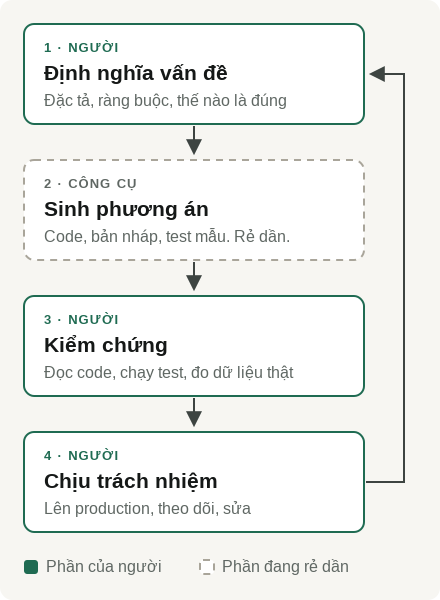
The way I work now is the loop in the picture. Write down what “correct” means before handing work to a tool. Treat everything it returns as a draft, even when it looks fine. Ship it to production yourself and watch it. Step two is the only one getting cheaper; the other three are still your job.
To find out if you’re actually faster, measure outcomes: how long from picking up a ticket to production, how many bugs slip through after each release, how many times you had to roll back (go back to the old version). Don’t go by feel; the METR trial above shows how far off feel can be.
Every now and then, do a hard part without the tool: an algorithm, a migration (a script that changes the database structure), tracing an incident from scratch yourself. Pilots with autopilot still practice landing by hand.
If AI is an amplifier, then tests, CI (the system that builds and runs tests every time you push code), code review and a clean architecture decide whether it plays music or static. Time spent on them pays off more than ever.
And if you’re just starting out: build a real product end to end. Real users, real bugs, real numbers, then write down why you made the calls you made. One project like that is worth more than ten todo apps, and it shows employers exactly what they’re missing.
Final words
Pocket calculators made multiplication cheap, but they didn’t kill accounting. The valuable part moved elsewhere: understanding what the numbers mean. Software is going through something similar. Typing code keeps getting cheaper. Knowing what the problem is, knowing what a right answer looks like, and being willing to sign your name and own it are still expensive, maybe more than before.
The tools change every month, so some of this may stop being true soon. If you see it differently, or have better data, message me, and if you’re free let’s grab a coffee and keep the chat going.
Nguồn tham khảo
-
Brynjolfsson, E., Li, D., & Raymond, L. (2025). Generative AI at Work. The Quarterly Journal of Economics, 140(2), 889–942. Working paper version: NBER w31161. ↩
-
METR (07/2025). Measuring the Impact of Early-2025 AI on Experienced Open-Source Developer Productivity. Paper: arXiv:2507.09089. ↩
-
METR (02/2026). Uplift update. ↩
-
Stack Overflow (07/2025). 2025 Developer Survey: AI. Summary on the Stack Overflow Blog. ↩
-
Google Cloud DORA (2024). Accelerate State of DevOps Report 2024. The 1.5% and 7.2% figures per the Google Cloud Blog (10/2024). ↩
-
Google Cloud DORA (2025). State of AI-assisted Software Development. Summary on the Google Cloud Blog (09/2025). ↩
-
Brynjolfsson, E., Chandar, B., & Chen, R. Canaries in the Coal Mine? Six Facts about the Recent Employment Effects of Artificial Intelligence. Stanford Digital Economy Lab, versions from 08/2025 to 08/2026. Overview page: digitaleconomy.stanford.edu. ↩
-
World Economic Forum (01/2025). The Future of Jobs Report 2025: Skills outlook. ↩
Share
Feedback on this post
This is my personal experience and point of view, so there are surely gaps or things I got wrong. If so, I apologise in advance and would really appreciate you pointing them out. Feedback goes privately to my email and is never shown publicly.
Want to dig deeper? Let's grab a coffee and chat, online or in person.
Grab a coffeeThank you! I have received your feedback and will reply by email.
Your feedback was not sent: please check your name, email and message.