Jensen Huang: what to praise, what to criticize
He stuck with CUDA from 2006 and won big with AI. But customer lock-in, steep prices and a company leaning on one man deserve straight talk too.

Contents
If you write code for a living, you have probably heard a lot about Jensen Huang lately: GPUs are expensive, Nvidia stock is in the news every week, and his “kids don’t need to learn to code” line made plenty of people nervous. So is he the real deal, or just hype? This post splits the praise from the criticism, and ends with a few lessons you can actually use in your own career.
Short version: he stuck with one technical bet for well over a decade and it finally paid off big. But the things that made Nvidia win, an ecosystem that is easy to enter and hard to leave and a company built around one man, are also its weakest spots. You could see that clearly in the last two weeks of November 2026: on November 12 Nvidia announced his resignation1, and on November 23 the board unanimously brought him back2. Praise is easy. Criticism that hits the right spot is harder. This post does both.
Who he is
Jensen Huang was born on February 17, 1963 in Taiwan and was sent to the US at nine, before he could speak English well. Relatives put him and his brother in the Oneida Baptist Institute in Kentucky, thinking it was a fancy boarding school. It turned out to be a school for troubled kids3. At 15 he worked at a Denny’s in Portland. In his words: “I was a dishwasher, I was a busboy, I waited tables”4. He then studied electrical engineering at Oregon State (1984), got a master’s at Stanford (1992), and worked at AMD and LSI Logic3.
In 1993 he, Chris Malachowsky and Curtis Priem planned Nvidia in another Denny’s in Silicon Valley, because “it had all the coffee you could drink and no one could chase you out”4. He has been CEO since day one3, more than 33 years now, minus the last 11 days.
The good: four things that are hard to copy
1. Betting on CUDA before anyone needed it. In 2006 Nvidia launched CUDA5. In plain terms, CUDA is a toolkit that lets programmers use a graphics card (GPU) to run huge numbers of calculations at once for science and research, not just to draw game graphics. The hard part was not the tech. It was the decision to put CUDA on every GeForce gaming card. Huang told Lex Fridman that this “cost the company enormous amounts of our profits, and we couldn’t afford it at the time. But we did it anyway because we wanted to be a computing company”. As he remembers it, the company’s market value dropped to around $1.5 billion at one point6. At NTU’s 2023 commencement he himself called it “an expensive, long-term investment that drew much criticism,” and recalled that shareholders were skeptical of CUDA and preferred the company improve profitability7. Twenty years later, more than 7.5 million developers use CUDA and Nvidia’s tools8. It is like a noodle shop giving away free fried dough when nobody likes fried dough. Then the whole street gets hooked, and only one shop already has a fryer.
2. Seeing AI early and going all in. In 2012, Nvidia GPUs ran AlexNet, the moment that kicked off AI as we know it today5. In 2016 Huang personally carried the first DGX-1, list price $129,000, to OpenAI’s office in San Francisco9. By the third quarter of fiscal 2027, Nvidia reported revenue of $115.8 billion, $107.6 billion of it from the data center business alone10. To be fair, Huang himself says CUDA did not succeed because of three founders but because of “43,000 people” at the company, plus the millions of developers who trusted them6.
3. Surviving, and knowing when to walk away. One of Nvidia’s early big contracts was a graphics chip for a Sega game console. The market changed direction, Nvidia had to drop the contract and nearly went bankrupt, saved only because Sega’s leadership helped out7. In 2010 Nvidia jumped into phone chips, then got out just as fast once that market became a commodity, where anyone can make the product and margins are thin. He said: “By leaving the phone market, we opened our minds to invent a new one”7, meaning robots and self-driving cars. He still says he has used the line “30 days from going out of business” for 33 years, and that he is “always in a state of anxiety”11. Sounds exhausting, but in my view this kind of worry makes people more careful, not more panicked.
4. A flat company where information takes the short road. In March 2026 he said about 60 people report directly to him, and he does not do private one-on-ones with any of them because “it’s impossible”. Instead the whole group looks at a problem together6. At Stanford he explained: “They never hear me say something to them, that is only for them to know”12. In my view this is the cheapest cure for office rumors: if you want to know what the boss thinks, come to the shared meeting and listen.
The bad: four things worth arguing about
1. CUDA is a moat, and the customers are standing inside it. Huang says outright that Nvidia’s most valuable asset is the number of people using CUDA, so much so that “if somebody came up with a GUDA or TUDA, it wouldn’t make any difference at all”6. For shareholders, that is an advantage. For customers, it is the price of switching to someone else. In 2023, Arm, Fujitsu, Google Cloud, Imagination, Intel, Qualcomm and Samsung joined the Unified Acceleration Foundation, which aims to build an open, cross-platform programming standard for accelerator chips13. Defenders have a point: developers get a stable platform that Nvidia has maintained for twenty years. Critics have a point too: a whole industry has to follow one vendor’s roadmap. In my view Nvidia dug this moat with hard work, not tricks, but users should know which side of it they are standing on.
2. High prices, even higher margins. In 2023, H100s were at one point listed on eBay for roughly $40,000 to just under $46,000 each14. In Q3 of fiscal 2027, Nvidia’s GAAP gross margin was 74.8%10, meaning that out of every $100 in sales, almost $75 is left after the cost of making the product, before operating expenses. You can argue that is the market price for a product that costs a fortune in research, with demand outrunning supply. You can also argue that for startups, universities and developing countries like Vietnam, that price puts computing power out of reach.
3. The “kids don’t need to learn to code” line. At the World Governments Summit on February 12, 2024, he said that for a decade or so everyone told kids to learn computer science, and now it is the opposite: the industry’s job is to build technology so nobody has to program15. In March 2024 he added that programming is not required to succeed, “but if somebody wants to learn to do so, please do, because we’re hiring programmers”16. In my view, the first line is right as a product direction but not sound as advice for your kids. Skipping coding because AI can write code is like skipping math because calculators exist: the machine presses the buttons, but knowing which calculation to run is still a human job. To be fair, in 2026 he put it much better: the purpose of your job and the tools you use to do it “are related, not the same”6. I’ll take the 2026 version.
4. Too many eggs in too few baskets. Basket one is customers: in fiscal 2026, two direct customers alone made up 22% and 14% of revenue8. Basket two is China: in April 2025 the US started requiring an export license to ship the H20 chip to China, citing the “risk that the [H20] may be used in … a supercomputer in China”17, and Nvidia took a $4.5 billion charge for H20 inventory8. Huang called export controls “a failure”18, while the US Commerce Department says the restrictions aim to keep advanced technologies out of the wrong hands18. Both sides have their reasons, and Nvidia is stuck in the middle, so much that its Q4 fiscal 2027 outlook counts zero data center compute revenue from China10. Basket three is the man himself: the November 12, 2026 release gave no reason for his resignation and named CFO Colette Kress interim CEO1. On November 23 the board unanimously reinstated him while a committee of independent directors continues its investigation into reports of a foreign intelligence effort targeting him2. I will not get into the personal matters the press reported around this. What I care about is how the company is built: Fortune argues that the flat structure with no clear successor may have made succession planning harder19. Many direct reports (he said about 60 in March 2026; Fortune, citing Business Insider, says 36) keep information moving fast, but it may also mean nobody gets to practice being “number two”.
What developers can take from this
- Bet long, but have something that pays the bills now. Huang likes to call Nvidia “the house that GeForce built”: gaming cards paid for CUDA through the years when nobody needed it6. If you want to go deep on systems, GPUs or the math behind AI, go for it, but keep a steady paycheck so you can keep digging.
- People follow platforms, not features. Developers stick with CUDA because they trust Nvidia to keep it working from version 1 to version 136. Same with your internal libraries or APIs: new versions that do not break old code are the cheapest way to earn trust.
- Know what you are locked into. When you pick a technology, count the cost of leaving it later. No need to avoid Nvidia, just know where the exit is before you need it.
- Don’t stop at half the sentence. “No need to learn to code” is only the first half. The second half is “we’re hiring programmers.” Tools change. People who understand the problem and the system still get paid.
- Walking away is a skill too. Dropping Sega, dropping phones, every retreat freed up energy for a bigger bet7. If a side project is going nowhere, stopping at the right time is also a kind of win.
- Be open, but train your replacement. Shared meetings help the whole team know the same thing. But if only one person understands the whole system, the team freezes the day that person leaves, whether it is a trillion-dollar company or a five-person team.
Bottom line: I think Jensen Huang deserves most of the praise, especially for sticking with CUDA. But a great company should not only be solid while its founder is on stage. If you think I praised too much or did not criticize hard enough somewhere, message me, and if you are free, let’s grab a coffee and keep talking.
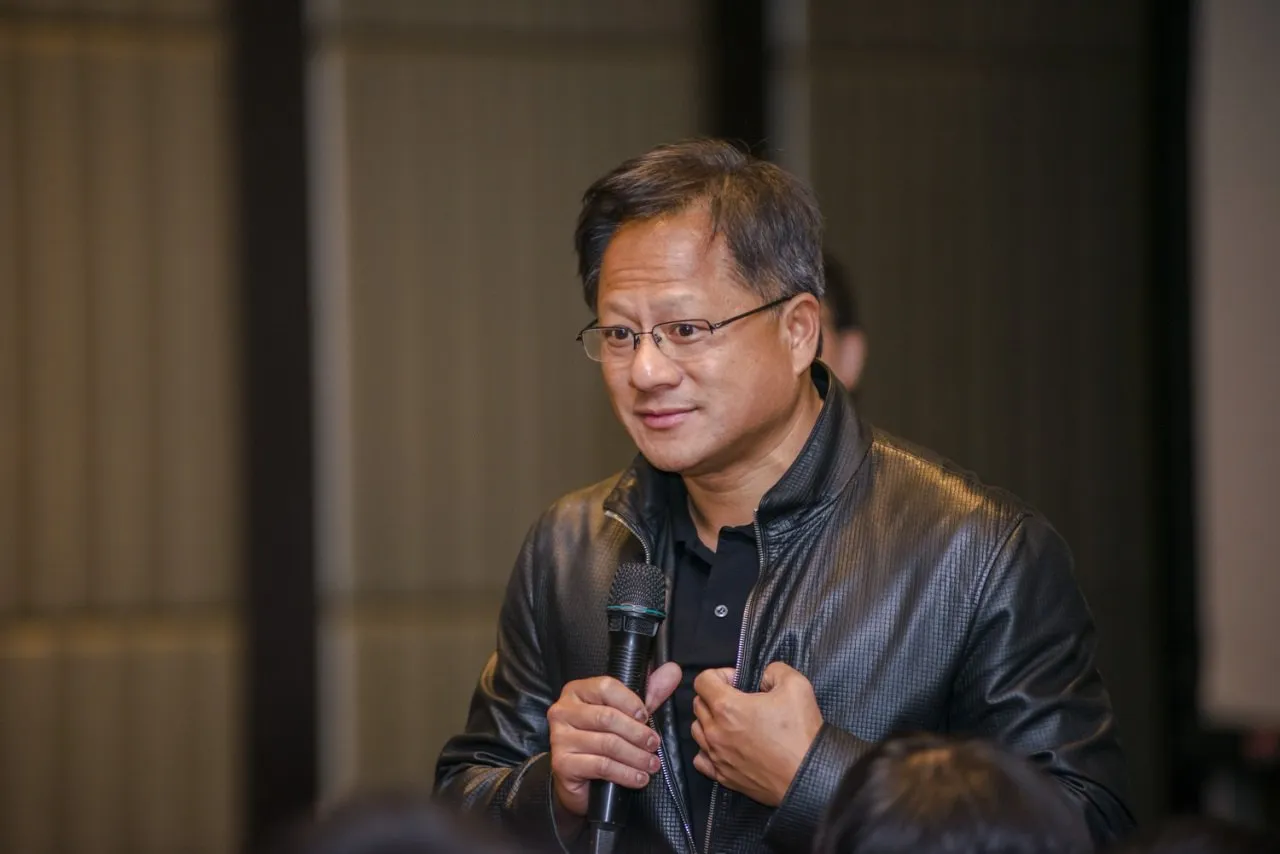
Cover photo: NVIDIA Taiwan, Wikimedia Commons, CC BY 2.0.
Nguồn tham khảo
-
NVIDIA Newsroom, “NVIDIA Announces CEO Transition” (Nov 12, 2026). ↩ ↩2
-
NVIDIA, Form 8-K Exhibit, “NVIDIA Board Reinstates Jensen Huang as President, CEO and Board Director” (Nov 23, 2026). ↩ ↩2
-
Wikipedia, “Jensen Huang” (accessed Nov 27, 2026). ↩ ↩2 ↩3
-
NVIDIA Blog, “NVIDIA Founder and CEO Jensen Huang Returns to Denny’s Where NVIDIA Launched a Trillion-Dollar Vision” (Sep 26, 2023). ↩ ↩2
-
NVIDIA, “Corporate Timeline” (accessed Nov 27, 2026). ↩ ↩2
-
Lex Fridman Podcast #494, “Transcript for Jensen Huang: NVIDIA – The $4 Trillion Company & the AI Revolution” (Mar 23, 2026). ↩ ↩2 ↩3 ↩4 ↩5 ↩6 ↩7
-
NVIDIA Blog, “NVIDIA CEO Tells NTU Grads to Run, Not Walk — But Be Prepared to Stumble” (May 26, 2023). ↩ ↩2 ↩3 ↩4
-
NVIDIA, “Form 10-K, fiscal year 2026” (fiscal year ended Jan 25, 2026). ↩ ↩2 ↩3
-
Fortune, “Elon Musk’s Artificial Intelligence Project Just Got a Free Supercomputer” (Aug 15, 2016). ↩
-
NVIDIA Investor Relations, “NVIDIA Announces Financial Results for Third Quarter Fiscal 2027” (Nov 17, 2026). ↩ ↩2 ↩3
-
Fortune, “Nvidia CEO admits he works 7 days a week, including holidays, in a constant state of anxiety out of fear of going bankrupt” (Dec 4, 2025). ↩
-
Fortune, “Jensen Huang had a strict no one-on-one meetings rule for his 60 direct reports” (Jun 12, 2024). ↩
-
Linux Foundation, “Unified Acceleration Foundation Forms to Drive Open Accelerated Compute and Cross-Platform Performance” (Sep 19, 2023). ↩
-
CNBC, “Nvidia’s top A.I. chips are selling for more than $40,000 on eBay” (Apr 14, 2023). ↩
-
World Governments Summit, “Omar Al Olama interviews founder of NVIDIA: Who Will Shape the Future of AI?” (Feb 12, 2024). ↩
-
TechRadar, “Nvidia CEO says don’t give up learning new skills — just maybe leave programming to AI” (Mar 21, 2024). ↩
-
TechCrunch, “Nvidia H20 chip exports hit with license requirement by US government” (Apr 15, 2025). ↩
-
Fortune, “Jensen Huang blasts U.S. curbs on the sale of Nvidia chips to China: ‘Export control was a failure’” (May 22, 2025). ↩ ↩2
-
Fortune, “36 direct reports, no heir apparent: How Jensen Huang’s ‘flat’ org may have hampered Nvidia’s succession planning” (Nov 12, 2026). ↩
Share
Feedback on this post
This is my personal experience and point of view, so there are surely gaps or things I got wrong. If so, I apologise in advance and would really appreciate you pointing them out. Feedback goes privately to my email and is never shown publicly.
Want to dig deeper? Let's grab a coffee and chat, online or in person.
Grab a coffeeThank you! I have received your feedback and will reply by email.
Your feedback was not sent: please check your name, email and message.